
Strength Analysis of a Metal Bridge for the Modular Fast Bridge Launching Vehicle Using the Finite Element Method
Article Sidebar
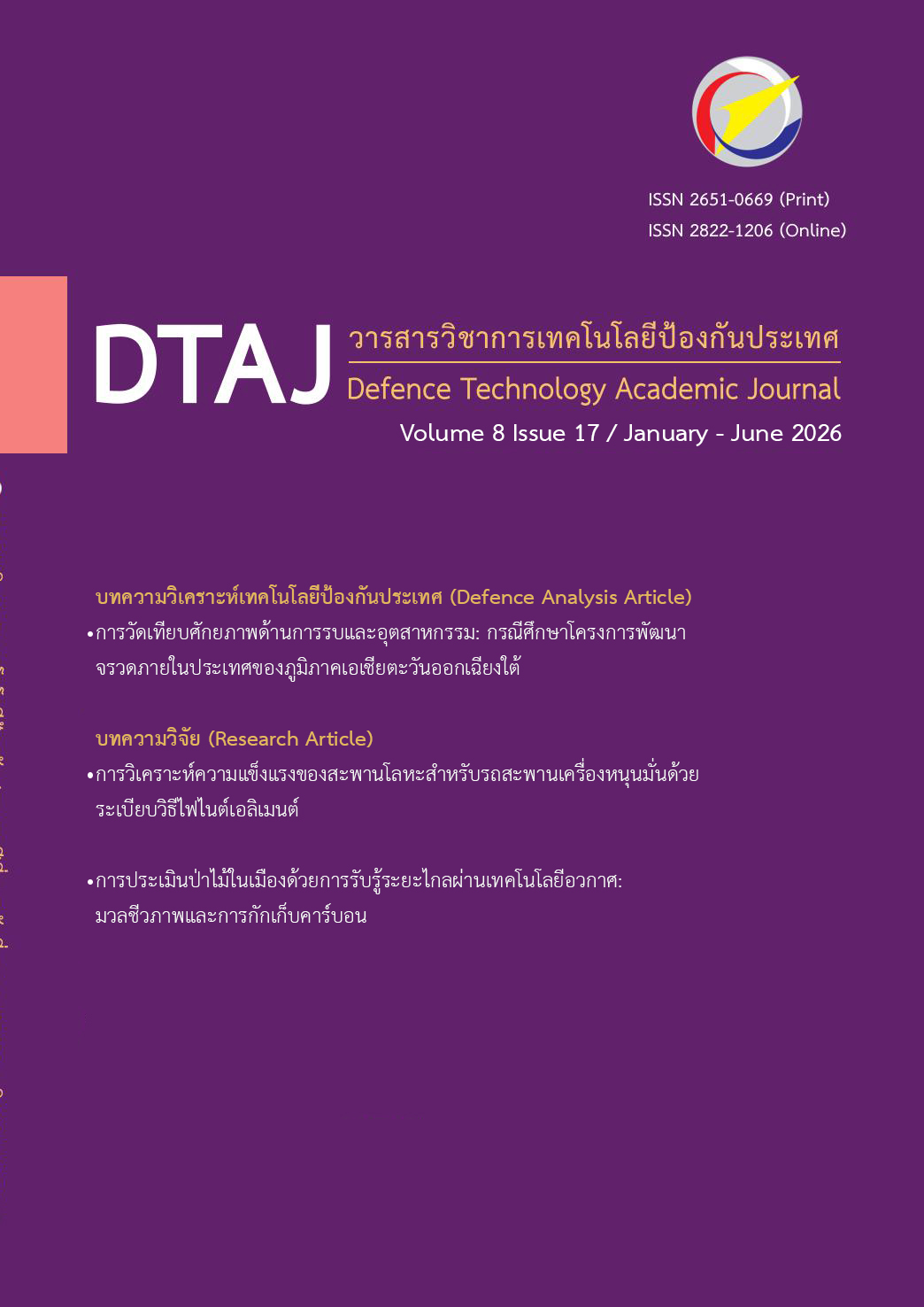
Main Article Content
Abstract
The Modular Fast Bridge (MFB) is military equipment used for tactical support missions,
enabling the transport of vehicles, equipment, or personnel across canals or disrupted routes. Additionally, it is utilized in disaster relief operations to assist civilians when transportation routes are cut off. This study presents a strength analysis of a steel bridge capable using the Finite Element Method (FEM). The analysis focuses on evaluating the stress and strain of the bridge structure. Furthermore, the strength of steel bridge was tested by placing 60-ton load on the middle of the bridge and the tested results were used to compare against the results obtained from FEM. The results from the calculations and experiments showed that both were in good agreement, and the maximum stress occurred at the midpoint of the bridge, where the two bridge sections are connected.
Downloads
Article Details

This work is licensed under a Creative Commons Attribution-NonCommercial-NoDerivatives 4.0 International License.
Journal of TCI is licensed under a Creative Commons Attribution-NonCommercial-NoDerivatives 4.0 International (CC BY-NC-ND 4.0) licence, unless otherwise stated. Please read our Policies page for more information...
References
O. C. Zienkiewicz, R. L. Taylor, and J. Z. Zhu, “The standard discrete system and origins of the finite element method,”
in The Finite Element Method: Its Basis and Fundamentals, 6th ed. Burlington, MA, USA: Butterworth-Heinemann, 2005, pp. 1–13.
X. Yang et al., “Structural analysis and optimization of steel truss bridge based on finite element method,” in Proc. 3rd
Int. Conf. on Frontiers of Mech. Eng. and Chem. Eng. (CONF-FMCE), Aug. 2023, pp. 102–108.
M. Embaby and M. H. El Naggar, “Experimental and analytical investigation for modular double truss bridge,” Eng.
Struct., vol. 322, part A, Jan. 2025, Art. no. 119106. doi: 10.1016/j.engstruct.2024.119106.
W. Intharasuwan, N. Nutayasakul, T. Ngamcharungchit, and T. Somsri, “Feasibility study on the development of military bridging for the Royal Thai Army (การศึกษาความเป็นไปได้ในการพัฒนาสร้างสะพานทหารช่างของกองทัพบก),” Chulachomklao Royal Mil. Acad. J., Nakhon Nayok, Thailand, Jul. 2020.
J. Hornbeck et al., “Trilateral design and test code for military bridging and gap-crossing equipment,” Defense Technical Information Center (DTIC), Fort Belvoir, VA, USA, Tech. Rep., Jan. 2005.
N. Nutayasakul, P. Limjeejong, P. Phothisat, R. Manchusuntharakul, and K. Liaopairoj, “Analysis of MGB bridging system for suitability with current Royal Thai Army (การวิเคราะห์สะพานเครื่องหนุนมั่นแบบ MGB เพื่อความเหมาะสมกับกองทัพไทยในปัจจุบัน),” TumCivil, 2021. [Online]. Available: engfanatic.tumcivil.com. Accessed: Feb. 11, 2026.
D. Yong, Z. Wei, H. Lingxia, and T. K. Francis, “Effect of dynamic impact at modular bridge expansion joints on bridge design,” Eng. Struct., vol. 127, pp. 645–662, Nov. 2016. doi: 10.1016/j.engstruct.2016.09.001.
S. Boheng, D. Yong, and H. Lingxia, “Dynamic strength analysis and structural topology optimization of modular bridge expansion joints under vehicle impact loads,” Structures, vol. 74, Apr. 2025, Art. no. 108643. doi: 10.1016/j.istruc.2025.108643.
