
การประยุกต์ใช้ Discrete Element Method สำหรับการออกแบบอุปกรณ์กวาดล้างทุ่นระเบิด
Article Sidebar
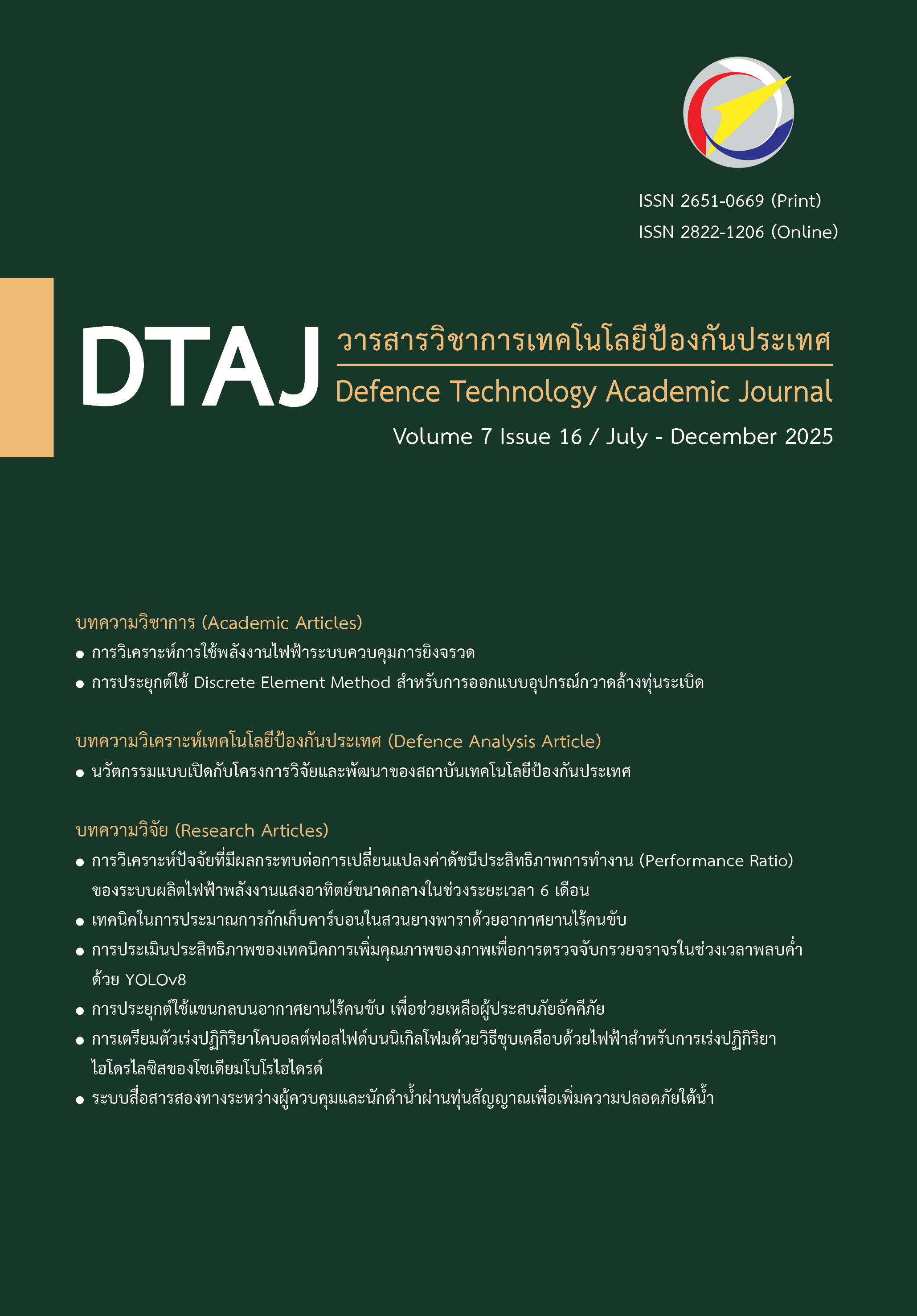
Main Article Content
บทคัดย่อ
ในการออกแบบอุปกรณ์กวาดล้างทุ่นระเบิด การพิจารณาแรงต้านจากดินและการทำนายพฤติกรรมทางกลศาสตร์ของดินมีความจำเป็นและสำคัญอย่างยิ่งต่อประสิทธิภาพต่อประสิทธิภาพในการกวาดล้างทุ่นระเบิดโดยการคำนวณแรงต้านดินเชิงทฤษฎีด้วยของ Reece และศึกษาพฤติกรรมของกลศาสตร์ของดินโดยการประยุกต์ใช้ระเบียบวิธีแบบองค์ประกอบไม่ต่อเนื่อง (Discrete Element Method, DEM) ซึ่งผลจากการคำนวณแรงต้านทานโดยสมการของ Reece และการพิจารณาแรงที่เกิดขึ้นจริงระหว่างอนุภาคดินกับใบไถในระดับจุลภาคด้วย DEM แสดงให้เห็นว่าแรงที่ได้จาก DEM มีการเพิ่มขึ้นตามความลึกของการไถและมค่ามากกว่าค่ำที่คำนวณโดยใช้ทฤษฎี ค่าของแรงที่สูงขั้นนี้เป็ฯผลมาจากพฤติกรรมการกระทำระหว่างอนุภาคดินที่มีการสัมผัสและผลักดันเป็นช่วงๆ ส่งผลให้ค่าแรงจากระเบียบวิธีองค์ประกอบไม่ต่อเนื่อง มีค่าสูงกว่าที่ได้จากการคำนวณแบบเชิงทฤษฎีมากถึง 30% ที่การไถที่ความลึก 0.3 เมตร สำหรับการไถที่ความลึกน้อยกว่า 0.15 เมตรนั้น ค่าแรงต้านทานจากทฤษฎีและจากระเบียบวิธีองค์ประกอบไม่ต่อเนื่องนั้นมีค่าใกล้เคียงกัน ผลจากการจำลองด้วยระเบียบวิธีองค์ประกอบไม่ต่อเนื่องสามารถทำนายพฤติกรรมการตัดของดินและแสดงพฤติกรรมการไหลของดินผ่านใบมีดได้อย่างละเอียด ซึ่งเป็นข้อมูลสำคัญสำหรับการออกแบบและปรับปรุงใบมีดให้มีประสิทธิภาพสูงขึ้นต่อไป
Downloads
Article Details

อนุญาตภายใต้เงื่อนไข Creative Commons Attribution-NonCommercial-NoDerivatives 4.0 International License.
Journal of TCI is licensed under a Creative Commons Attribution-NonCommercial-NoDerivatives 4.0 International (CC BY-NC-ND 4.0) licence, unless otherwise stated. Please read our Policies page for more information...
เอกสารอ้างอิง
Pearson Engineering, “Route opening mine plough.” [Online]. Available: https://www.pearson-eng.com/product/route-opening-mine-plough/. Accessed: Oct. 1, 2024.
A. R. Reece, “The fundamental equation of earth-moving mechanics,” Proc. Inst. Mech. Eng., vol. 179, pp. 16-22, 1964.
E. McKyes, Soil Cutting and Tillage. Amsterdam, The Netherlands: Elsevier Science Publishers B.V., 1985.
H. P. Harrison, “Soil reacting forces for models of three bentleg plows,” Soil Tillage Res., vol. 14, no. 4, pp. 325-340, 1989.
S. H. Hoseinian et al., “Development of a dual sideway-share subsurface tillage tool,” Soil Tillage Res., vol. 216, Art. no. 105247, 2022.
M. R. Bashir and A. Yahya, “Simulation of soil-tool interaction using finite element method and discrete element method: A review,” Comput. Electron. Agric., vol. 127, pp. 615-626,
S. Murray, “Modelling of soil-tool interactions using the discrete element method,” M.Sc. thesis, Dept. Biosyst. Eng., Univ. Manitoba, Winnipeg, MB, Canada, 2016.
W. R. Gill and G. E. Vanden Berg, Soil Dynamics in Tillage and Traction, USDA Agric. Handbook No. 316. Washington, DC, USA: U.S. Government Printing Office, 1968.
K. Bagi, Introduction to Discrete Element Methods: A Numerical Method for Granular and Discontinuous Materials. Cham, Switzerland: Springer, 2022.
M. Marigo and J. P. K. Seville, “Discrete element method (DEM) for industrial applications,” KONA Powder Part. J., vol. 32, pp. 201-223, 2015.
C. Kloss, C. Goniva, A. Hager, S. Amberger, and S. Pirker, “Models, algorithms and validation for open source DEM and CFD-DEM,” Prog. Comput. Fluid Dyn., vol. 12, no. 2-3, pp. 140-152, 2012.
L. Lyle and N. P. Woodruff, “Surface soil cloddiness in relation to soil density at time of tillage,” Soil Sci., vol. 91, no. 3, pp. 150-159, 1961.
